
Integrating a New Social Feature in Spotify
Seamlessly integrate a new social feature to help expand Spotify’s social capabilities and help users connect with each other on a deeper level through music.
Summary
Spotify’s mission is clear: “to help people listen to whatever music they want, whenever they want, wherever they want—in a completely legal and accessible way.” As a streaming music service, Spotify is the group lead and it wants to stay that way. In order to help Spotify improve engagement and retention in the app, Spotify wants to expand its social capabilities. For this project, I designed a new social feature in order to help people connect with each other through music.
Timeline
My Role
Tools
2 Weeks (Oct-Nov 2021)
I took the UX research, and visual design.
Figma
Project Overview
Challenges
Seamlessly integrate a new social feature to help expand Spotify’s social capabilities and help users connect with each other on a deeper level through music.
Solutions
-
A Mood & Activity feature that allows users to share their current mood and activity with friends and create personalized radios
-
A Recommendations feature that allows users to help their friends discover new music
Design Process

Research
To better understand Spotify’s background, market space, and who Spotify’s users are, I started by conducting research with the following goals:
Research Goals
-
Understand the market trends of the music streaming industry
-
Identify Spotify’s target market
-
Identify Spotify’s competitors and evaluate their strengths and weaknesses
-
Understand the role music plays in people’s social lives
-
Understand the experiences people have with music streaming services
-
Discover goals, needs, motivations, and frustrations of music streaming users
Market Research
In order to gain more insights on what the current music streaming industry looks like, I decided to start with market research. Through market research, I was able to get a deeper understanding of the current trends of Spotify’s market based on data gathered from secondary research.
General
-
Spotify has become the most popular global audio streaming subscription service
-
The top competitors of Spotify are YouTube, Pandora, Apple Music, Amazon Prime Music, SoundCloud, and Google Play Music.
-
Over 20,000 songs are added everyday on the platform.
-
Spotify deprecated their Inbox/Messaging feature due to lack of user engagement
Usage
-
44% of users listen to Spotify on a daily basis
-
Around a third of Spotify listening time is spent on Spotify-generated playlists, with another third going on user-generated playlists
-
Average users listen to 41 unique artists per week
-
In each region, Spotify listening is dominated by mobile.
-
Spotify listeners frequently turn to the streaming service to soundtrack special occasions.
-
In 2019 more than 60 million users engaged with this feature (Annual “Your Top Songs”), sharing content 40 million times and streaming 6.5 billion songs from the playlists.
Demographics
-
286 million monthly active users of Spotify
-
Spotify is the most-popular channel with under-30s
-
29% of Spotify users are millennials
-
As of March 2018, Spotify’s user base was dominated by Millennials, with 29 percent of its users aged 25 to 34 and 26 percent aged between 18 and 24 years old
-
According to a 2018 survey, Spotify reaches almost half of 16 to 24 year olds in the United States each week
-
Spotify has the most youthful user base of the three platforms (Apple, Spotify, Pandora), with over half of users aged 34 or under, compared with 40% of Apple and 39% of Pandora users
Provisional Personas
Now that I had a better understanding of Spotify’s market space through market research and competitive analysis, I wanted to start exploring and identifying who their target users might be. By creating provisional personas, I was able to quickly start empathizing with Spotify’s users and gain a basis for who I would conduct user interviews with to validate this information.

Empathy Map
Through the user interviews, I found that while many people had their own, unique experiences with music and music streaming, there were common patterns across the role music played in their lives socially, how they listen to music, and how they discovered music. Using an empathy map, I was able to synthesize all of the findings and uncover these key insights.

From the information gathered, I was able to identify common patterns that allowed me to uncover key insights which would help me to understand our user’s needs on a deeper level.
Insights
-
People build connections with other people through music
-
People tend to be doing other things while listening to music
-
People want to discover new music that they like
Needs
-
To be able to experience music with other people
-
To be able to find music appropriate for the current situation
-
To be able to find accurate recommendations
Brainstorming
I started the brainstorming process with mind mapping. Based on the HMW questions, I went through 10 minute rounds for each question and quickly generated as many different ideas as possible. I then went back in for a last round, 5 minutes each, to write down any new ideas or expand on existing ones.

Rough user flow map
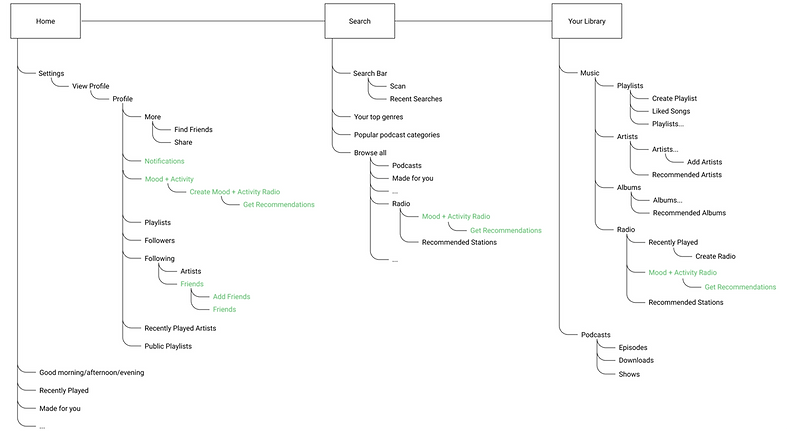
Site map
Task Flow
Now that I knew how these new features would fit into Spotify’s existing structure, I wanted to explore how the user’s would be interacting with these new features to complete key tasks. I first created a UI Requirements document to identify the key tasks based on our user’s goals, and then clearly laid out the specific requirements for each screen in order for the user to successfully complete those tasks.
Using the same key tasks, I created task flows to understand the actions the users would take and the key pages they would interact with to complete those tasks.

Task flow
Wireframe Sketches
Using everything I learned throughout this phase, I then worked on creating lofi wireframe sketches to make informed decisions on how to design these new screens to help our users complete these tasks and meet their goals.


Wireframes
Prototype
In order to test the design decisions I had made and to test the usability of the design, I wanted to create a prototype to test on real users.Following my wireframes, I then used Figma to create an interactive high fidelity, limited functionality prototype that I would use for usability testing.

Final Prototype made in Figma
Conclusion
I faced new challenges during this project that I haven’t faced before - seamlessly integrating a new feature into an existing design and designing for a mobile application that I wasn’t entirely familiar with.
Through this project, I learned the importance of really diving into studying the existing design and flow of the application to introduce a new feature that looks and feels like Spotify’s existing design. Doing research on the background and how the app evolved was also key to identifying the best solutions for the problems at hand.